
Competition Coffee: What We Sent to Houston, and Why

Right now, two of our coffees are sitting on a judging table in Houston at the Global Coffee Awards. We find out how they did on September 9th. Here's what we sent, how it got there — including the part where we didn't actually have the coffee — and what we've done before.
What we entered
Two lots, both chosen because they say something about how we buy:
Luna Azul — grown by Andrés Cardona in Santa Bárbara, Antioquia. This is the coffee that started our whole relationship with him, before the dryer, before the hectare, before any of it. Entering it felt like the right way to make the point.
Sebastian Ramírez Watermelon Co-Ferment — a coffee that wears its method in its name, and one of the most joyful things we've ever put in a bag. If you want to know what a co-ferment even is, we wrote a field guide to exotic processing.
The problem: we had none of it
We committed to entering Luna Azul and then realized we had no green coffee to roast. Our own lot is still in Colombia, on the patio, months from shipping.
So we called our friends at Perc Coffee in Savannah, who had Luna Azul green in their warehouse. They overnighted it to us. We roasted it here, hand-sorted it bean by bean, and overnighted it to Houston.
That's worth sitting with for a second. A coffee off a smallholding in Antioquia is being judged against the world's best — and it got there because a roaster in Georgia opened their warehouse for a competitor on a phone call. That happens constantly in this trade and almost nobody outside it sees it.
Why the hand sorting matters
Competition coffee gets sorted by hand after roasting: every quaker, every under-developed bean, every broken piece pulled out one at a time under a lamp. It is genuinely tedious. But a single defective bean in a competition sample can drag a score down, and the judges are tasting hundreds of coffees. You don't get a second impression.
It's the same reason we sort what goes in your bag, just taken to an unreasonable extreme.
Five bronze medals at Golden Bean
Competition roasting is one of the pillars this place was built on. Golden Bean North America is the largest coffee roasting competition in the world — roasters from the United States, Canada and Mexico submit coffees to be judged blind. We've entered three times and medaled every time.
2019 — two bronze. Over 1,300 entries that year. We sent two different roasts of the same coffee: "Marta Ruby," a red honey processed bourbon. Both roasts took bronze in pour over. One coffee, two roast profiles, two medals — which tells you how much of the cup is decided after the beans arrive.
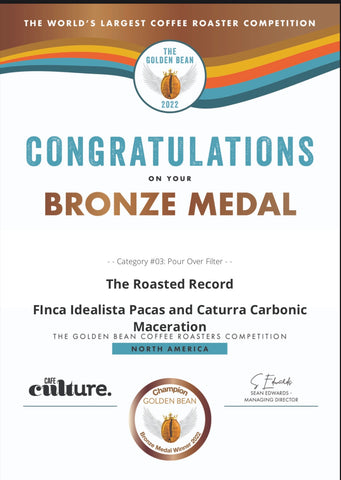
2022, Columbus, Ohio — two bronze. This time with Edwin Noreña's Bourbon Sidra and a Pacas and Caturra from Finca Idealista, a carbonic maceration. Both wildly exotic, both home runs on the table.

2023 — one more bronze, in Pour Over Filter, for Laderas Del Tapias — Catiope. That one is worth explaining. Catiope is an experimental hybrid released by Cenicafé, crossing Ethiopian heirloom with Colombian Castillo, and Laderas del Tapias was one of only two farms in all of Colombia chosen to plant it. Grown at 2,100 metres by Rodrigo Peláez — a dentist who also writes a coffee column for his local paper — and dried in mechanical silos over two weeks. Strawberry, dates, brown sugar, lemon.
Five bronze medals, three competitions.
The other competition: nowhere to hide
Golden Bean judges a coffee you chose and sourced yourself, which means a big part of the result is your buying. The US Coffee Championships strip that away entirely.
Every competitor is sent the same green coffee. Same lot, same beans, same weeks to work it out on your own machine. Nobody has a secret microlot. Nobody has a better relationship with a producer. The only variable left in the room is the roast — what you did with beans identical to everyone else's.
That's the whole competition, and it's why the result is uncomfortable to look at. Whatever separates the scores is you.
Nashville, January 11, 2020
Our first one. Same green as everybody else, and no idea what we were walking into. We finished 16th.
It turned out to be one of the last competitions anyone would run for a long time — the circuit shut down within weeks and didn't properly return for two years.

Denver, March 2023
Three years later we drove to Denver for the Roaster Preliminary. Twenty-three roasters. The top eight would advance to the national finals at the Specialty Coffee Expo in Portland.
Here is the whole scoreboard, exactly as it was posted. We finished 11th on 72.17. Eighth place — the last qualifying spot — scored 72.75.
| # | Roaster | City | Score |
|---|---|---|---|
| 1 | Huckleberry Roasters | Denver, CO | 78.25 |
| 2 | Paircupworks | Mesa, AZ | 76.50 |
| 3 | Black Oak Roasters | Ukiah, CA | 76.25 |
| 4 | Kafiex Roasters | Vancouver, WA | 76.00 |
| 5 | Elevator Coffee | Portland, OR | 75.50 |
| 6 | Equator | San Rafael, CA | 74.58 |
| 7 | White Nene Coffee Roasters | Kona, HI | 73.83 |
| 8 | Theory Coffee Roasters | Redding, CA | 72.75 |
| — CUT LINE: top 8 advance to the finals in Portland — | |||
| 9 | Copper Door Roasters | Denver, CO | 72.75 |
| 10 | Presta Coffee | Tucson, AZ | 72.50 |
| 11 | The Roasted Record | Stuart, FL | 72.17 |
| 12 | Olympia Coffee Roasters | Olympia, WA | 72.17 |
| 13 | La Barba Coffee | Salt Lake City, UT | 72.17 |
| 14 | Reverie Coffee Roasters | Wichita, KS | 72.00 |
| 15 | Caffe Ibis | Logan, UT | 71.83 |
| 16 | Gabee Coffee | Boulder, CO | 71.75 |
| 17 | Aroma Craft Coffee | Walnut, CA | 71.67 |
| 18 | Coracle Coffee | Tulsa, OK | 71.33 |
| 19 | Ilustre Specialty Coffee | San Diego, CA | 69.92 |
| 20 | Westrock Coffee Roasters | Little Rock, AR | 69.92 |
| 21 | Three Story Coffee | Jefferson City, MO | 69.25 |
| 22 | Zelie Beans Coffee | Sugar Land, TX | 68.08 |
| 23 | Be Bright Coffee | Los Angeles, CA | 68.00 |
Three roasters finished on exactly 72.17 that day — us, Olympia Coffee Roasters and La Barba — and we took 11th on tiebreakers. The room was won by Huckleberry Roasters, on their home ground in Denver.
16th, then 11th
That's the number we actually care about. Nashville 2020: 16th. Denver 2023: 11th. Five places better, and half a point off the national finals.
Nobody hands you a medal for eleventh. But when every roaster in the country gets the identical coffee, the scoreboard is the only honest one in this business — it can't be gamed with a spectacular lot or a good story — and ours says we got better. That's worth more to us than the placing.
And one we lost on a loading dock
Honesty being the house policy: we entered the Global Coffee Awards in 2025 too. We shipped two-day a few days before the cutoff, and the coffee arrived a day late. It wasn't judged. Hand-sorted, competition-ready coffee that never made it onto a table.
This year we overnighted everything.
Why we keep doing it
Not for the medals, though we'll happily take them. Competition keeps us honest — blind judging doesn't care about your story or your label or how nice your bags look. And it keeps us in the room with the people and processing methods pushing this industry forward, which is how coffees like the banana-leaf ferment on Andrés's farm end up in our hands in the first place.
What happens on September 9th
We find out. If we place, you'll hear about it — probably more than once, if we're honest. If we don't, that goes here too — the same way we publish every farm report on the paper trail, whether it says what we hoped or not.
In the meantime, both coffees are on the shelf. Taste them and judge for yourself — you'll beat the judges by three weeks.


